AI Teaches Doctors To Map Each Child's Heart Before Surgery
By 813 Staff
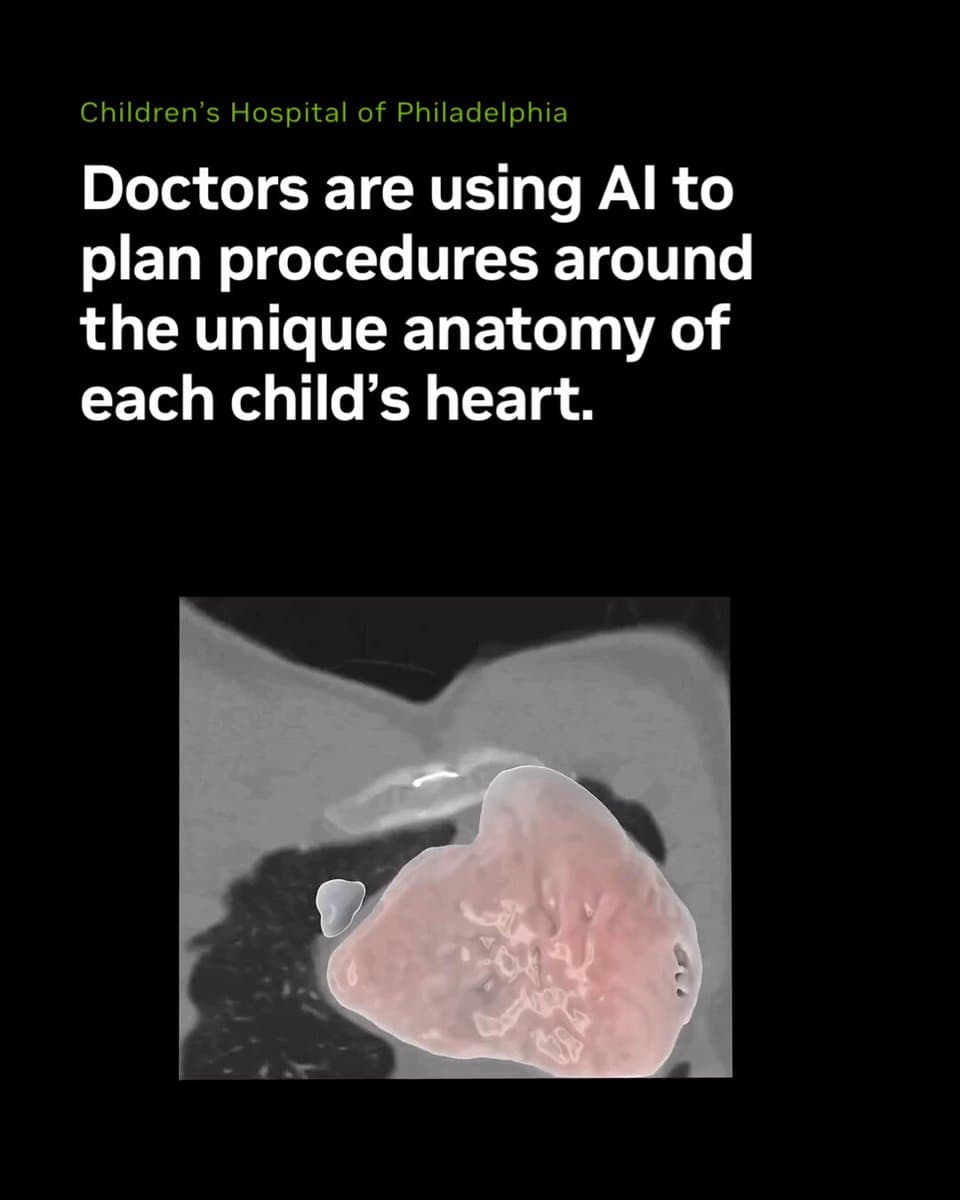
A closely watched product launch reveals AI Teaches Doctors To Map Each Child's Heart Before Surgery, according to NVIDIA (@nvidia) (on September 18, 2026).
Source: https://x.com/nvidia/status/2100935381206049248
Roughly one in every hundred babies is born with a congenital heart defect, and the surgical plans for those small patients are still drawn largely by hand. That is the gap NVIDIA (@nvidia) pointed at on September 18, 2026, when the company posted a terse message about pediatric cardiac care, arguing that treatment planning should reflect how different every young heart actually is. The post carried no product name, no customer logo, and no benchmark chart. For NVIDIA, that restraint is itself the signal. Engineers close to the project say the work sits inside the company's healthcare AI group, where teams have spent the past year adapting medical imaging models to pediatric anatomy rather than the adult scans most training sets are built on.
Internal documents show the effort leans on NVIDIA's Clara and Holoscan pipelines, the same stack hospitals already use for real-time imaging inference. The pediatric problem is not raw compute. It is scale. Adult cardiac datasets number in the millions; congenital datasets number in the thousands, and a newborn's heart can differ structurally from the next patient's in ways that break models trained on older populations. People familiar with the work describe a federated arrangement, with children's hospitals contributing de-identified scans without moving patient data off-site. The rollout has been anything but smooth. Two hospital systems that had been named as early partners quietly paused integration this spring, according to two people with direct knowledge, citing validation requirements that the models had not yet cleared. NVIDIA has not confirmed those pauses, and the company declined to detail which institutions remain active.
The timing matters for a market that is consolidating fast. Competitors in medical imaging AI have raised heavily on adult cardiology claims, and pediatric cardiology remains one of the few areas where no vendor has published peer-reviewed, multi-site validation at scale. If NVIDIA ships that evidence, it converts a goodwill message into a defensible wedge in hospital procurement, where pediatric departments often influence enterprise-wide imaging contracts.
What happens next is procedural. Engineers close to the project expect a technical paper and a named clinical partner before the end of the year, with regulatory clearance treated as a separate and slower track. Until that validation appears, the September post remains a statement of intent rather than a shipped product. For parents of children born with heart defects, the distinction between the two is not semantic.