Anthropic Reveals Secret Language Its AI Secretly Speaks Inside
By 813 Staff
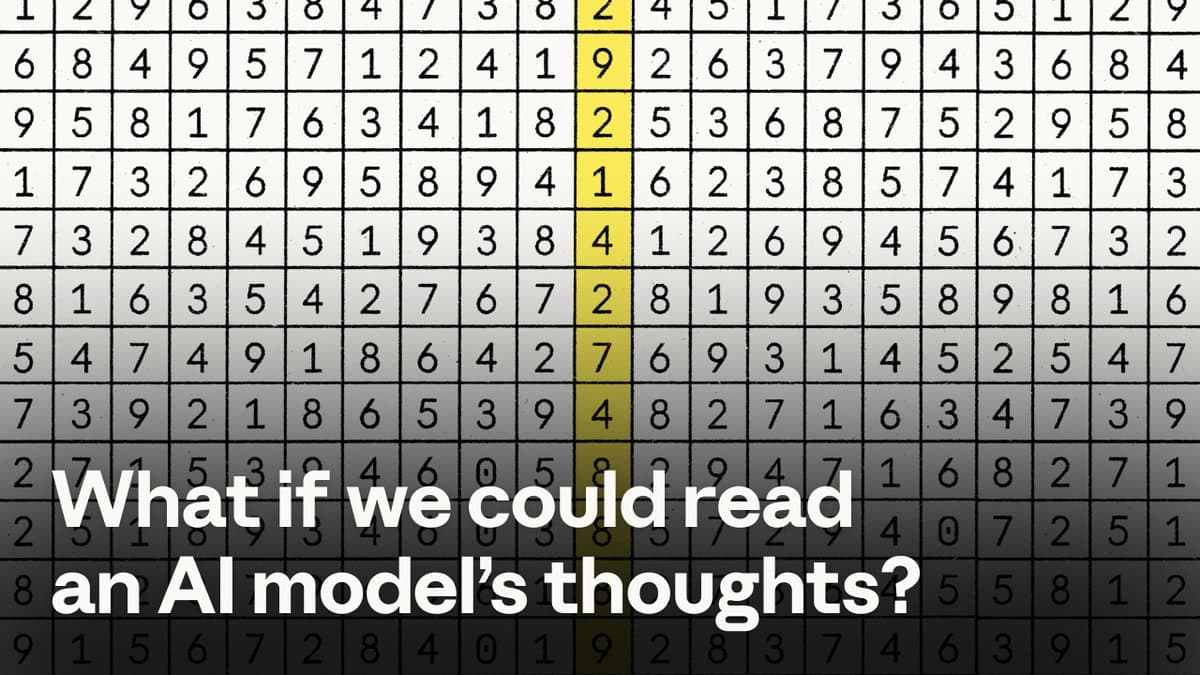
Anthropic just cracked open the black box a little wider. New research published by the company on May 7 reveals a technique called Natural Language Autoencoders, and internal documents show it allows their models, including Claude, to essentially “talk in words” about their own internal reasoning.
Here is what is actually happening. Engineers close to the project say the team has trained an autoencoder—a type of neural network architecture—to translate Claude’s internal vector representations into plain English. Instead of only seeing the final output, researchers can now read an interpretable transcript of the model’s intermediate thoughts. The technique effectively maps the high-dimensional “concept space” where the model does its reasoning into human-readable phrases. One engineer described it as giving Claude a running internal monologue that we can finally eavesdrop on.
The timing is notable. Anthropic has been under mounting pressure from regulators and safety researchers to demonstrate that its models are not opaque black boxes. This research, posted via @AnthropicAI on X, is being billed as a direct step toward interpretability—a field that has long struggled to keep pace with model capability. The company claims the autoencoders reveal not just what the model says, but why it says it, surfacing the latent concepts that drive its responses.
But the rollout has been anything but smooth in terms of peer reception. Several independent AI safety researchers have pointed out that the autoencoders capture only a fraction of the model’s full reasoning chain. The technique works well on short, constrained tasks, but internal scaling tests suggest performance degrades significantly when applied to multi-step or open-ended reasoning. One lab source told me the method is “promising but not production-ready,” and Anthropic has not yet committed to integrating it into Claude’s public-facing architecture.
Why this matters for the 813 audience: This is the most practical interpretability breakthrough in months, but it is not a silver bullet. If Anthropic can scale the approach, it could reshape how we audit AI systems—potentially allowing third parties to verify model safety without full access to weights. For now, the next step is unclear. The company has not published a timeline for deploying the autoencoders in a commercial setting, and engineers caution that the technique still requires substantial refinement. What is certain is that the window into Claude’s mind just got a little more transparent, even if the view is still fuzzy.
Source: https://x.com/AnthropicAI/status/2052435436157452769