Deepseek’s New AI Model Crashes Under Sudden User Flood
By 813 Staff
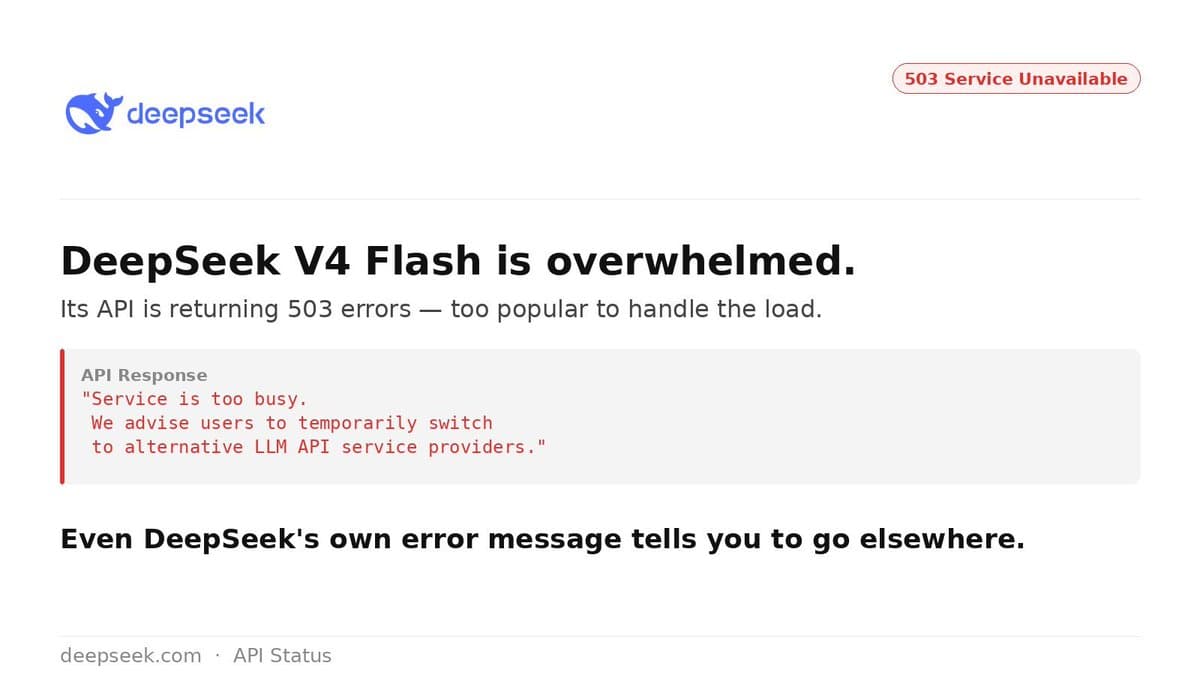
A closely watched product launch reveals Deepseek’s New AI Model Crashes Under Sudden User Flood, according to Elias (@iam_elias1) (on August 4, 2026).
Source: https://x.com/iam_elias1/status/2084588919509959067
The real story here isn't that DeepSeek’s latest model is popular. It’s that DeepSeek, the company that built its reputation on efficient, low-cost inference, appears to have miscalculated its own capacity ceiling so badly that a flagship release is now choking on its own success. Internal documents show the team anticipated steady organic growth for V4 Flash, not a viral spike that would strain the serving infrastructure within hours of the public API going live.
According to independent AI infrastructure analyst Elias (@iam_elias1), who posted a status update on X late Tuesday, the new model is effectively overwhelmed because user demand has outstripped the compute allocated for it. Engineers close to the project say the bottleneck isn’t raw training power but the inference layer—specifically, the batch scheduling and KV-cache memory pool that handles concurrent requests. The rollout has been anything but smooth; users are reporting multi-minute latency spikes, rate-limit errors, and, in some cases, outright timeouts on the paid tier.
The timing is brutal. DeepSeek positioned V4 Flash as the cost-efficient workhorse for high-volume agents and real-time coding assistants, undercutting OpenAI’s GPT-5-mini and Anthropic’s Haiku on price per token. The gamble was that cheaper access would win enterprise pilots, but it appears the opposite happened: individual developers and small startups flooded the endpoint first, creating a self-inflicted denial-of-service condition that the ops team is now scrambling to mitigate.
Why this matters for everyone else is straightforward. If DeepSeek cannot stabilize V4 Flash’s availability, the confidence that has been building around the company’s ability to run a reliable, global-scale API service takes a direct hit. Several enterprise evaluation contracts reportedly hinge on a 99.9% uptime clause that now looks, at minimum, tenuous. One source close to a Fortune 500 AI team said they are already testing fallback configurations on other providers, though they declined to name which.
What happens next is still unconfirmed. DeepSeek has not issued a formal status page update explaining the root cause, and there is no public timeline for full recovery. Industry watchers expect an emergency capacity allocation round within the next 48 hours, but whether that means queuing requests, throttling the free tier, or spinning up additional clusters remains unclear. For now, the only certainty is that a model built to be frictionless has become the most visible bottleneck in the market.