Kernel Flaw Gives Hackers Total System Control Without Leaving A Trace
By 813 Staff
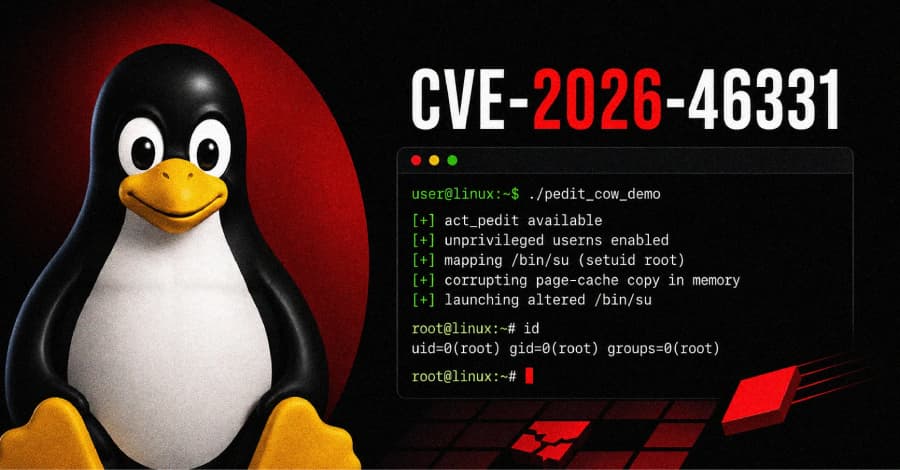
Tech industry sources confirm Kernel Flaw Gives Hackers Total System Control Without Leaving A Trace, according to The Hacker News (@TheHackersNews) (in the last 24 hours).
Source: https://x.com/TheHackersNews/status/2070528444568645906
The internal Slack channels at the major operating system vendors lit up within hours of the public disclosure, but the panic had already been simmering for days among the kernel security teams. Engineers close to the project describe a frantic scramble to patch a flaw that, as internal documents show, allows an attacker to achieve root access without so much as editing a single file on disk. The vulnerability, designated CVE-2026-46331, was first flagged by an independent researcher who spotted anomalous memory mapping behavior in the Linux kernel’s handling of shared page tables. What makes this exploit uniquely dangerous is its signature: it operates entirely in memory, leaving no forensic trace for traditional file integrity monitors.
According to the breaking report from @TheHackersNews, the exploit bypasses several modern kernel hardening features, including Supervisor Mode Execution Prevention and kernel address space layout randomization. The attacker gains full root privileges simply by crafting a series of ioctl calls that trigger an out-of-bounds write in the kernel’s virtual memory management subsystem. The exploit does not require any user interaction beyond convincing the target to run a single binary—no file overwrites, no cron job installations, no logs modified. Several cybersecurity firms have confirmed that proof-of-concept code is already circulating in private Telegram channels frequented by state-sponsored threat actors.
The rollout has been anything but smooth. The initial patch from the Linux kernel release team was pulled from the stable tree just six hours after publication, after internal testing revealed it introduced a separate system instability for ARM-based server configurations. A revised patch is now under accelerated review, with a target release window of early next week. For enterprise security teams, this means a precarious window: the exploit is verified, the targeted kernels are widely deployed across cloud providers, and no fully tested fix is yet available. Mitigations currently involve disabling transparent hugepages and enabling strict memory access auditing at the cost of roughly 8% system performance overhead.
What happens next hinges on how quickly the kernel community can stabilize the revised patch. The vulnerability affects all Linux distributions using kernel versions 6.12 through 6.19, which includes virtually every major cloud and enterprise environment. For readers managing production workloads, the safest immediate step is to apply the partial workaround and monitor for any unexpected privileged process spawns. This is a reminder that the most insidious exploits are often the ones that don’t touch a single line of stored text.
Source: https://x.com/TheHackersNews/status/2070528444568645906